
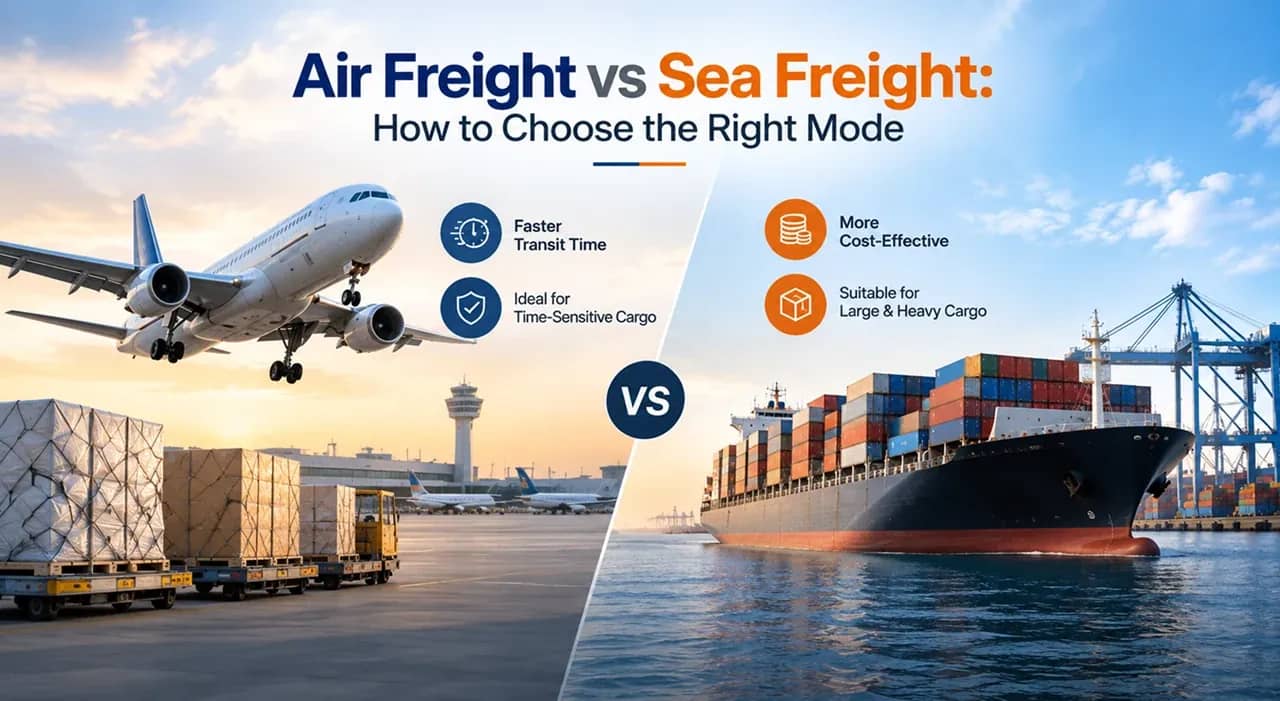

Air or sea? It is one of the first questions on any international shipment, and the answer changes the cost, the transit time and sometimes the viability of the order itself. Neither mode is universally better. The right choice depends on what you are moving, how quickly it has to arrive and what the cargo is worth.
How Air Freight Works
Air freight moves your cargo on scheduled passenger or dedicated freighter aircraft. Transit between most major trade lanes takes a few days rather than weeks, and flight frequency means there is usually another departure soon if you miss one.
Air cargo is priced on chargeable weight — the greater of actual weight and volumetric weight. Light but bulky cargo is therefore charged on the space it occupies, which is why low-density goods are expensive to fly.
How Sea Freight Works
Sea freight moves cargo in containers on scheduled vessel services. Transit is measured in weeks and sailings are typically weekly on a given lane, so the schedule needs more planning. In exchange, the cost per kilogram is a fraction of air freight and there is effectively no practical ceiling on volume or weight.
Ocean cargo is booked either as a full container (FCL) or as a shared container (LCL). If you are weighing those two up, our guide to FCL and LCL covers the trade-off in detail.
Air vs Sea: The Key Differences
| Factor | Air Freight | Sea Freight |
|---|---|---|
| Transit time | Days | Weeks |
| Cost | Considerably higher | Much lower per kg |
| Charged on | Chargeable weight | Container, or CBM for LCL |
| Best cargo | Light, urgent, high-value | Heavy, bulky, non-urgent |
| Frequency | Daily on most lanes | Usually weekly sailings |
| Capacity limits | Size and weight restricted | Very few practical limits |
| Insurance cost | Generally lower | Generally higher |
When Air Freight Is Worth the Premium
- The delivery deadline cannot move — a production line stoppage or a seasonal window
- The goods are high-value relative to their weight, so freight is a small share of the total
- The cargo is perishable or has a short shelf life
- You are shipping samples, spares or an urgent replacement
- Holding weeks of extra stock would cost more than flying it
When Sea Freight Is the Better Call
- The volume or weight would make air freight uneconomical
- You have planned far enough ahead to absorb a longer transit
- The goods are durable and not time-sensitive
- You are moving machinery, raw materials or bulk consignments
- Freight cost is a meaningful share of the landed cost
A Simple Way to Decide
Compare the freight difference against what the delay actually costs you. If flying a consignment costs a few hundred dollars more but prevents a line stoppage or a cancelled order, it pays for itself. If the goods will sit in a warehouse either way, that premium buys nothing. Many businesses use both: sea for planned replenishment, air for urgent top-ups.
How AR Global Logistics Helps
We quote both modes side by side so you can see the real cost and time difference for your own cargo rather than working from rules of thumb. Whichever you choose, we handle booking, pickup, documentation, customs clearance and final delivery through one point of contact.
Conclusion / Summary
Air freight buys time; sea freight buys capacity at a lower cost. Weigh the freight premium against the real cost of waiting, and let the cargo's value, weight and deadline decide. When it is close, ask for both quotes before you commit.
Still deciding between air and sea?
Services Covered in This Post
Air Freight Services
When your shipment needs to reach its destination quickly, air freight can provide the speed and flexibility you need.
Explore Air Freight ServicesSea Freight – FCL & LCL
Sea freight is a practical choice for businesses moving larger volumes of cargo across international markets.
Explore Sea Freight – FCL & LCLDocumentation & Shipment Coordination
Proper documentation is essential for smooth international trade.
Explore Documentation & Shipment Coordination