
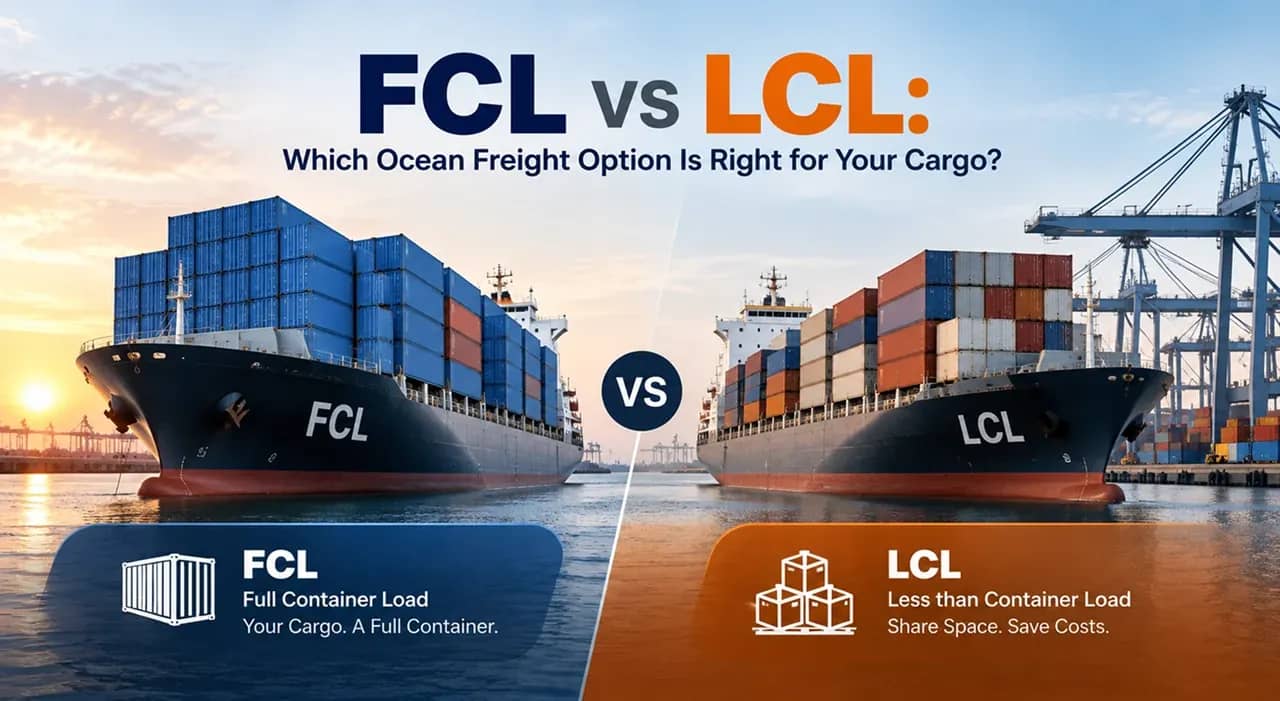

If you ship goods by sea, you have almost certainly come across two short abbreviations: FCL and LCL. They describe the two main ways to move ocean cargo, and choosing the right one has a direct impact on your shipping cost, transit time and how your goods are handled along the way. This guide breaks down the difference in plain language and gives you a simple way to decide.
What Does FCL Mean?
FCL stands for Full Container Load. With FCL, you book an entire container for your cargo alone — even if the goods do not physically fill every inch of it. The container is sealed at the origin and stays sealed until it reaches its destination, so your cargo is not mixed with anyone else's.
FCL is typically the better choice when you have enough volume to fill most of a container, when your goods are fragile or high-value, or when you want the fastest, most direct handling.
What Does LCL Mean?
LCL stands for Less than Container Load. With LCL, your cargo shares a container with shipments from other businesses. A consolidator combines several smaller loads into one container at origin and separates them again at destination.
LCL is ideal when you have a small shipment that would not justify the cost of a full container. You only pay for the space your cargo occupies, usually measured in cubic metres (CBM).
FCL vs LCL: The Key Differences
| Factor | FCL | LCL |
|---|---|---|
| Container | Entire container is yours | Shared with other shippers |
| Best for | Larger volumes | Smaller volumes |
| Cost basis | Flat rate per container | Per cubic metre (CBM) used |
| Transit time | Usually faster, more direct | May be slower (consolidation) |
| Cargo handling | Sealed origin to destination | Handled during consolidation |
| Risk exposure | Lower (not mixed) | Slightly higher (shared handling) |
When Should You Choose FCL?
- Your cargo fills roughly 15 CBM or more (a common rule of thumb)
- Your goods are fragile, high-value or sensitive to handling
- You want the fastest, most direct transit
- You prefer your cargo sealed and untouched until delivery
When Should You Choose LCL?
- You have a small shipment and don't need a full container
- You want to pay only for the space you actually use
- Your timeline is flexible enough to allow for consolidation
- You ship regularly in smaller batches
A Simple Way to Decide
As a starting point: if your cargo would fill more than half a container, FCL is usually more economical and safer. If it is well under that, LCL lets you avoid paying for empty space. The exact break-even point shifts with freight rates, cargo type and route — which is why it helps to compare both options for each shipment rather than assuming one is always cheaper.
How AR Global Logistics Helps
At AR Global Logistics, we compare FCL and LCL for every ocean shipment and recommend the option that balances cost, transit time and cargo safety for your specific consignment. From booking and container placement to documentation and delivery, we manage the full journey with a single point of contact — and get you a competitive quote within 24 hours.
Conclusion / Summary
FCL and LCL are simply two ways to share the cost of an ocean container. FCL gives you a container to yourself — faster and safer for larger or sensitive loads. LCL lets smaller shipments pay only for the space they use. Match the option to your volume, cargo type and timeline, and when in doubt, compare both before you book.
Not sure whether to ship FCL or LCL?
Services Covered in This Post
Sea Freight – FCL & LCL
Sea freight is a practical choice for businesses moving larger volumes of cargo across international markets.
Explore Sea Freight – FCL & LCLDocumentation & Shipment Coordination
Proper documentation is essential for smooth international trade.
Explore Documentation & Shipment Coordination